
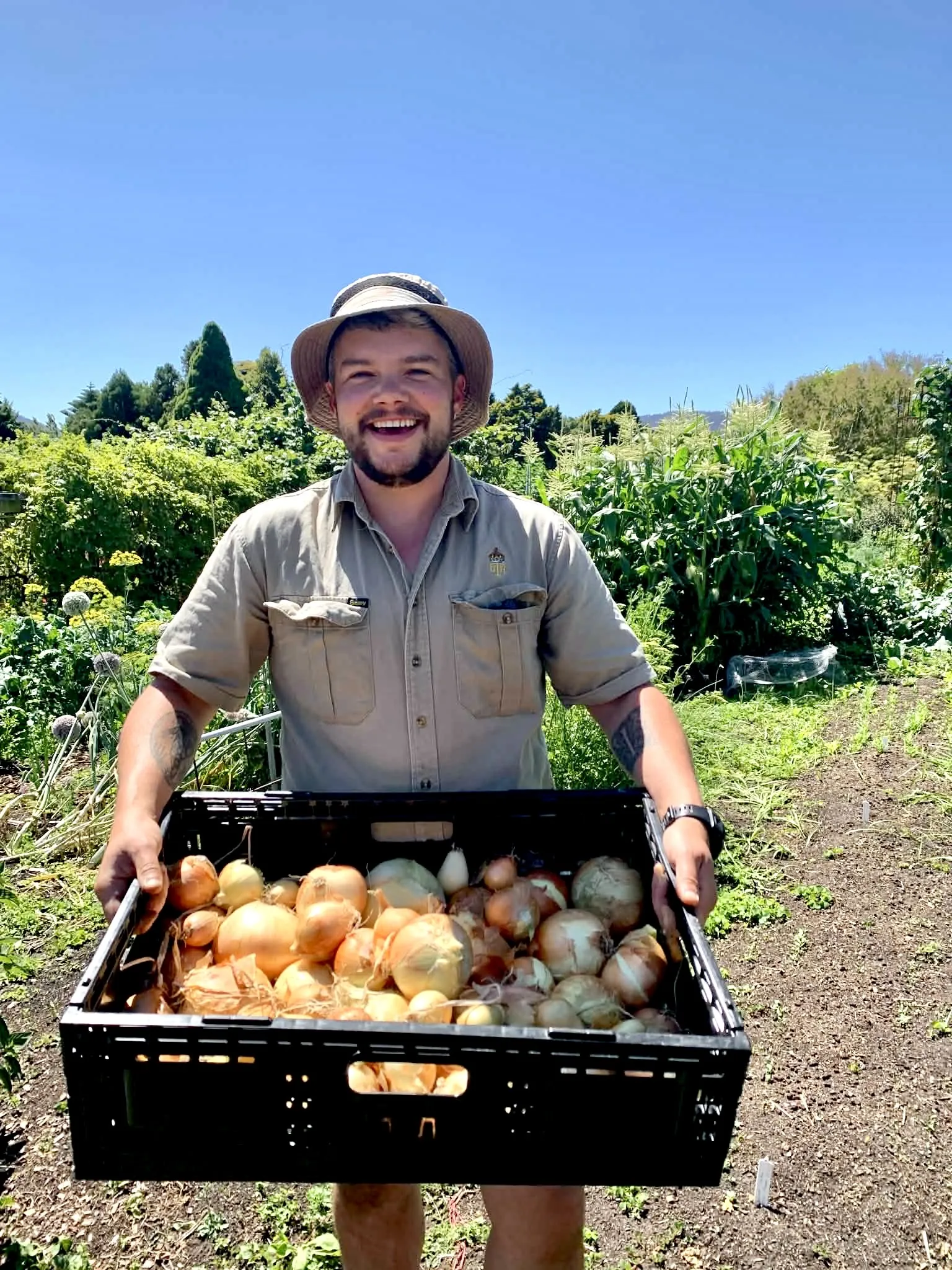
blair – Government house gardens
The farmer
Blaire’s mum takes great pride in telling people that Blaire’s favourite thing to do as a kid was sit in the dirt outside and eat raw onions. While this pastime hasn’t extended into adulthood, Blaire still spends quite a lot of time these days covered in dirt and handling onions, among other veggies.
Having studied fine arts, attempted science degrees, Blaire found gardening unexpectedly, but it made complete sense. Starting in 2018 on a large property in Fern Tree, he started his own gardening business Pademelon Gardening Service. While running this, he enrolled in the Diploma of Sustainable Living at UTAS during the chaos of covid, and followed this up with a Cert III in Horticulture.
Food production gardening didn’t come ‘till later, and this was a big change from the primarily ornamental gardening Blaire had been doing. Taking over the fruit and veggie garden at Government House at the peak of the growing season in late 2024, Blaire has quickly learned that running a large kitchen garden is as challenging as it is rewarding, and that radishes and beets make the best pop sound as they’re plucked from the ground, that celery rarely behaves itself, and so on and so forth.
The farm
Government House is a 15 hectare property, with ⅓ of it’s grounds dedicated to growing produce. This produce goes to the kitchen, who use it to feed the Governor of Tasmania, events in house, and for food donations. These donations also go out into the community regularly, with weekly collections made by Loaves and Fishes for the School Food Matters program, as well as other community groups.
The current kitchen garden space has been farmed intensively since the 1980’s, and has only in the last few years transitioned to have a permaculture, ecological, regenerative approach to farming. In the production areas there’s a nut orchard, hop, grape and kiwi fruit arbour, fruit orchard, polytunnel, vineyard, chicken coop, French garden and community garden.
The estate has a long history of food-growing, and Blaire sees the potential for it as a platform from which to educate, excite and champion the importance of sustainable, ethical and environmentally friendly food production and food access for everybody. He hopes that through the Sprout Small Producer Program, he can learn tools for efficiency, increased yield and quality, and general methods and techniques.